

DAMAS OLIVE 10Cr
Santoku with Granton Edge 18cm


DAMAS OLIVE 10Cr
Wusaki Knife Gift Set: 1 Santoku Knife + 1 Paring Knife


DAMAS OLIVE 10Cr
Wusaki Knife Gift Set: 1 Chef's Knife + 1 Utility Knife + 1 Paring Knife


DAMAS OLIVE 10Cr
Wusaki Knife Gift Set: 1 Santoku Knife + 1 Utility Knife + 1 Paring Knife


DAMAS OLIVE 10Cr
Wusaki Knife Case, 5 Kitchen Knives


SAKIN DAMAS 10Cr
Sakin Damascus 10Cr Kiritsuke Knife 20cm


SAKIN DAMAS 10Cr
Sakin Damascus 10Cr Chef's Knife 20cm


SAKIN DAMAS 10Cr
Sakin Damascus 10Cr Utility Knife 15cm
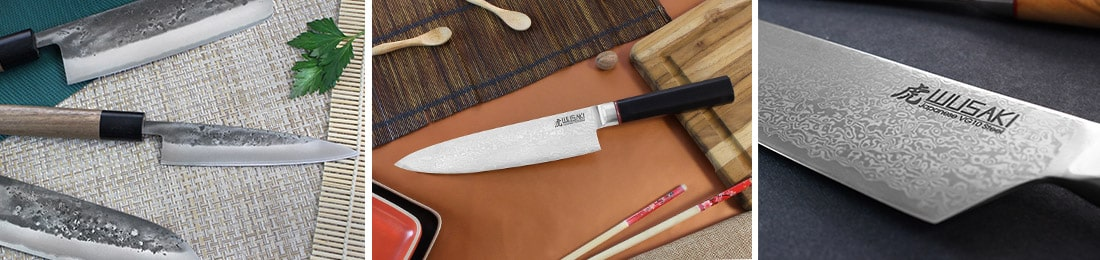
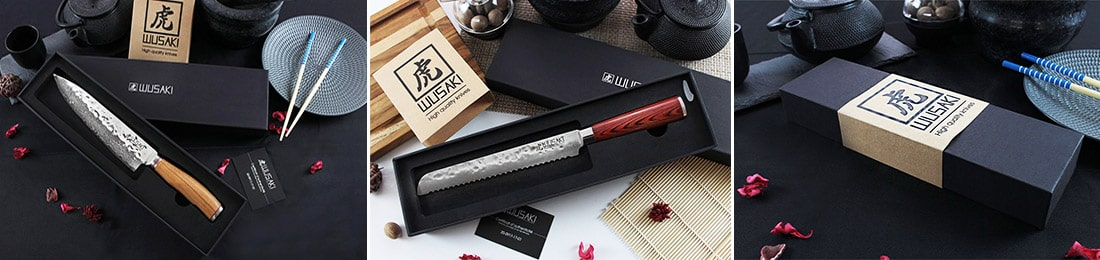
Discover here the prestigious ranges of Japanese Damas knives that we offer you. We offer 3 emblematic collections with elegant finishes that feature Damascus blades whose core is wrapped in 67 layers of high-end Japanese steel. Indeed, the Wusaki Fujiko VG10 and Damas VG10 knives stand out mainly for their distinguished olive wood handle, while those in the Wusaki Ebony VG10 family sport a sublime brown hue characteristic of ebony wood. Each of these major families includes models ranging from the essential Japanese chef's knife to the paring knife. We naturally also think of lovers of Japanese kitchen knives who want an assortment of several pieces to cook efficiently and in style, with our Wusaki Damas knife gift sets.
Blades described as Damascus are among the most sought-after and often the most expensive on the market. It's therefore worth knowing why they're so highly regarded by professionals and cutlery enthusiasts alike.
First of all, Japanese Damascus is forged by hammering together multiple sheets of steel. This complex manufacturing process requires both genuine expertise and a dose of creativity from the smith dedicated to this craft, often described as an artist. Indeed, the craftsman alternates layers of steel of different natures, both low and high in carbon (hard and soft). These are forged and then welded.
The major, unique mechanical strength of Damascus blades therefore comes from this combination of qualities from the 2 types of material used: the hardness of one for cutting properties, and the suppleness of the other for flexibility.
Moreover, when we talk about Damascus, we're also referring to the number of alternating steel layers, which can range from two to several hundred. This is where the singularity of the blade's final visual appearance comes into play. On one hand, the smith chooses the number of layers to stack. On the other hand, the intensity of contrast they wish to achieve through the acid-etching reveal process will bring out, to a greater or lesser degree, a pattern of winding or straight lines.