

Wusaki Sakimaru BS1 Handcrafted Japanese Knife, San Mai Blade 24cm

Engraving is not available: this knife is currently out of stock.
- Lead time: about 10 working days on top of delivery
- Fonts: a choice of 5 typefaces
- Limits: no special or Japanese characters, no other fonts
- Important: no exchange or refund on an engraved knife (nor on the set or case that contains it)
- A specific request? (another position, a drawing, symbol or size) write to us before ordering: hello@wusaki.com

Knife to engrave: Wusaki Sakimaru BS1 Handcrafted Japanese Knife, San Mai Blade 24cm. To engrave several knives, add one engraving per knife.
- Free shipping in mainland France
 Returns within 60 days
- Retour sous 60 jours

Description
Description
The Sakimaru: a premium handcrafted Japanese knife
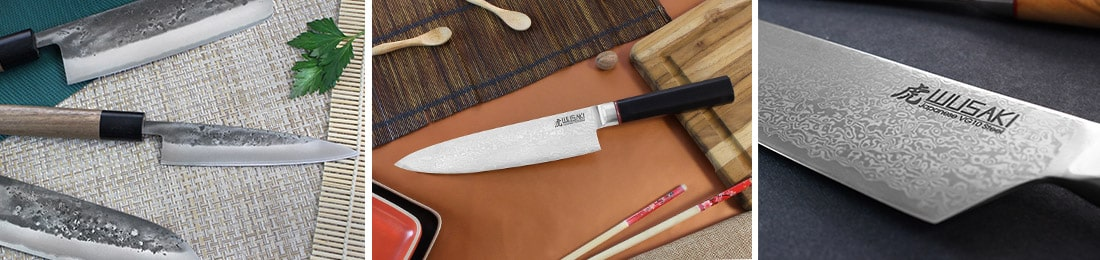
The Wusaki Sakimaru BS1 knife is especially well-suited to cutting large pieces of meat or fish. The blade of the Sakimaru knife is remarkably thin and long: this distinctive feature lets it slice through food in one continuous motion. The fineness of its edge helps preserve the texture and fibers of the food. Slices come out even, thin and consistent. Its slender shape and the blade's slight curve echo traditional Japanese swords. In Japan, chefs use it in particular for preparing sashimi.
A forged, carbon-enriched blade
The Wusaki Sakimaru knife is fitted with an Aogami 1 blade. This is a Japanese steel also known as Blue Steel 1, produced by the prestigious Japanese steelmaker Hitachi. With 1.3% carbon in its composition, Aogami stands apart from stainless steel and is fully considered a carbon steel. This high carbon content gives it an impressive hardness reaching 63 HRC! The result is a blade with long-lasting cutting quality that only needs infrequent sharpening. Aogami 1 is a costly alloy that calls for genuine expertise to work with.
The Sakimaru knife is the work of Tsunehisa, a small group of Japanese craftsmen who are experts in steelworking. This carefully selected steel is an oxidizable material, which therefore requires meticulous care. Advice on this is detailed at the end of the page. The blade also features a rough forged finish, giving it an authentic style naturally very popular with cooking professionals in Japan.
A "San Mai" structure for clean cuts
To design the blade, the craftsmen created what is known as a "San Mai" structure. These two words mean "3 layers" in Japanese, which in theory should already give you a clue. A hard steel core is clamped between two layers of a less rigid alloy. Only the Aogami cutting edge rises above the two soft steel plates to come into contact with the food being cut. The soft steel is added to offset the very high hardness of the central alloy, preventing the blade from becoming brittle.
The San Mai structure optimizes the blade's balance between rigidity and flexibility: it stays formidably sharp over time, while resisting shocks and repeated use. The craftsmen's work is also directly visible on the blade, where small waves testify to the layering of the steels. Beyond considerably improving the blade's performance, the San Mai structure reflects age-old know-how that gives the knife a rather special aura.
A rosewood handle and meticulous care
The handle of this handcrafted Japanese knife is made of rosewood. This very dense wood species stands out for its dark tone and sturdiness. It holds up well against moisture and impact. Its oval shape is an advantage, since beyond offering a comfortable grip, it makes the knife perfectly suited to both right- and left-handed users. The bolster connecting it to the blade is made of pakka wood, a very solid material combining layered wood and resin, hot-pressed together.
This high-end knife needs to be cared for carefully to preserve its qualities over time. It is recommended to clean it by hand and avoid letting it soak in the sink. The dishwasher, meanwhile, should be avoided entirely. Once clean, be sure to wipe it dry and let it become fully dry before putting it away. For extra protection, you can apply a mineral oil to the blade between uses.

Slice beautiful cuts of meat with a stunning handcrafted knife.
Care & sharpening
Care & sharpening
Use
- Cut with a straight, linear motion. Twisting motions damage the cutting edge and can break the blade.
- Use a wooden cutting board. Glass or marble dull the cutting edge over time.
Cleaning
- Wash by hand with a soft sponge and mild soap, then rinse with lukewarm water. Abrasive surfaces are not suitable for the steel.
- Oil the blade from time to time with a neutral mineral oil to protect it.
Sharpening
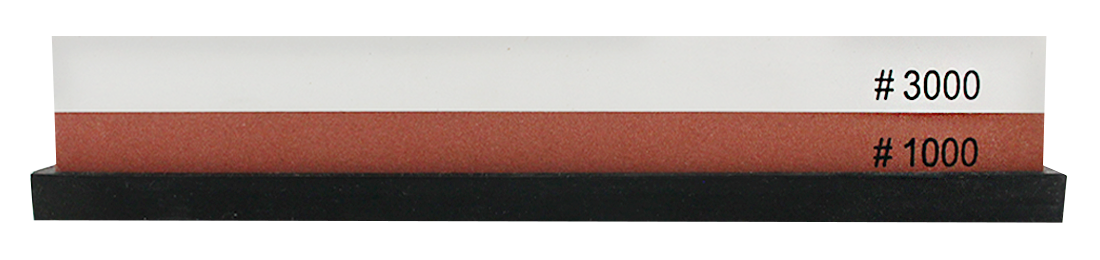
- Don't wait until the blade is completely dull: regular maintenance on a 1000-grit whetstone keeps an excellent cutting edge without removing too much material.
- Match the whetstone's grit to the condition of the blade — coarse grit to restore a very dull edge, fine grit to polish.
Specifications
Specifications
| Poids | 260 g |
|---|
Shipping & returns
Shipping & returns
Shipping
- Dispatch: within 24 to 48 hours after payment confirmation, for in-stock products.
- Delivery time: 3 to 7 days in mainland France, 5 to 10 days in Belgium.
- Fees: free shipping in mainland France. To Belgium, fees vary depending on the parcel's weight.
- Tracking: a tracking number is emailed to you as soon as your order ships.
Returns
- Returns accepted up to 60 days after purchase; the item must be new, unused, and in its original packaging.
- Refund within 10 business days after the return is received.
- If you exercise your right of withdrawal, the original shipping fees are deducted from the refund.