How to Care for Your Wusaki Knife?
How to Care for Your Wusaki Knife?
The quality of a kitchen knife does not lie in its toughness. High-end knives are designed with performance in mind, to reach exceptional levels of cutting precision. But in return, this results in a certain fragility that requires the user to pay particular attention to how the knife is used and cared for.
It would make sense to compare this to the world of cars, where a race car performs far more efficiently than a standard production car, but requires a whole battery of careful adjustments to reach its peak performance.

What Foods Should You Avoid Cutting with a Wusaki Knife?
Your Wusaki knife doesn’t respond well to contact with rigid foods, and would also rather avoid twisting motions. Certain foods therefore pose a risk to your knife.
-
Very hard fruits and vegetables such as red kuri squash, butternut squash, melon or watermelon should be avoided entirely. Their thick, rigid skin can cause chips along the cutting edge.
Because most Wusaki knives use a thin, hard blade, you’ll be forced to push harder into your cutting motion. Under this flexing force, the blade comes under tension and can then crack over several millimeters. This kind of damage can be repaired, but it will still cost you all the sharpening work done on your knife up to that point.
-
Contact with bones and fish bones should also be avoided. We strongly recommend removing all bones with a boning knife or a fillet knife before using your Wusaki knife. Your Wusaki knife lets you slice your cut of meat or fish thinly, thanks to its remarkable cutting quality.
-
The same goes for frozen foods, since your Wusaki blade cannot withstand that level of rigidity. Use a frozen-food knife instead, or at the very least a basic thick-bladed knife.
-
Any contact with a fruit pit can cause chips in the cutting edge. Take care when cutting peaches, plums, avocados or mangoes.
-
Hard cheeses (Emmental, Parmesan, Comté, Beaufort) also pose a potential risk. You’ll naturally be tempted to twist the blade sideways to slice through the rind, but this motion damages it.
What Type of Cutting Board Should You Use with a High-End Knife?
Without a doubt, the two types of cutting boards to favor when using your high-end knife are the wooden cutting board, as well as the plastic cutting board. Thanks to their softer surface, they protect the cutting edge of your blade, unlike glass or marble boards. These can cause chips along the edge from repeated, overly forceful impacts.

How to Properly Clean a Wusaki Knife?
First of all, make sure never to put your Wusaki knife in the dishwasher. Choose hand washing instead, with a little dish soap and a soft sponge. Then make sure to dry the knife completely with a cloth.
If air-dried or washed in the dishwasher, traces of rust or oxidation will appear on the blade. “Stainless” blades are also affected by this, as they generally have a carbon-enriched core, a component that is very sensitive to moisture.
The Wusaki knives that have no protective layer of stainless steel are even more exposed to rust. This is especially true of carbon steel knives or those with an iron cladding layer. The blades of these knives will inevitably develop coloring over time, even with careful maintenance. Small spots will appear, but it’s worth remembering that oxidation spots pose no risk to your health.
If you’d like to remove any excess rust on your blade, feel free to check out our dedicated page.

Where to Store Your Wusaki Knife?
How you store your knife shouldn’t be overlooked. Whenever possible, choose a spot where the blade can’t knock against other utensils. To avoid any impacts, you can fit your blade with a blade guard, or opt for a magnetic knife block. This holds your kitchen knives in place with a powerful magnet. Just make sure your knife is completely dry before placing it on the knife block, so it doesn’t end up air-drying on it.
How to Sharpen a Wusaki Knife?
Wusaki knives stand apart from Western knives thanks to their sharper sharpening angle and their generally more rigid alloy. The angle of a Wusaki knife averages 15°, while European knives range between 18° and 20°.
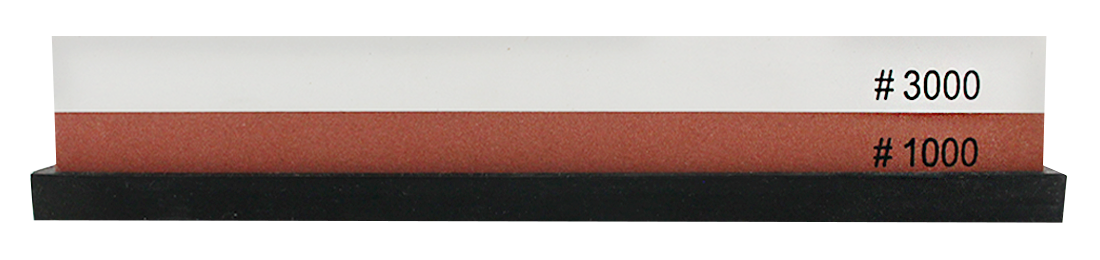
The whetstone is the most suitable tool for sharpening high-end knives such as Wusaki. The whetstone offers multiple benefits:
- afterward, the blade holds its edge for a long time, which can extend over several months.
- it offers the ability to repair a damaged blade: chips in the edge, a bent cutting edge, etc...
- it lets you reach your blade’s full potential with a razor-sharp finish that cannot be achieved with other sharpening methods.
We’ve put together a tips page for using your Wusaki whetstone to perfection.
Note: using manual or electric knife sharpeners is not recommended. These tools remove a large amount of material with every sharpening, significantly shortening the lifespan of your Wusaki knife. It would be a shame to cut short the longevity of a knife like this!